Why Architectural Veneer Plywood Beats Solid Wood for Shelves and Casework
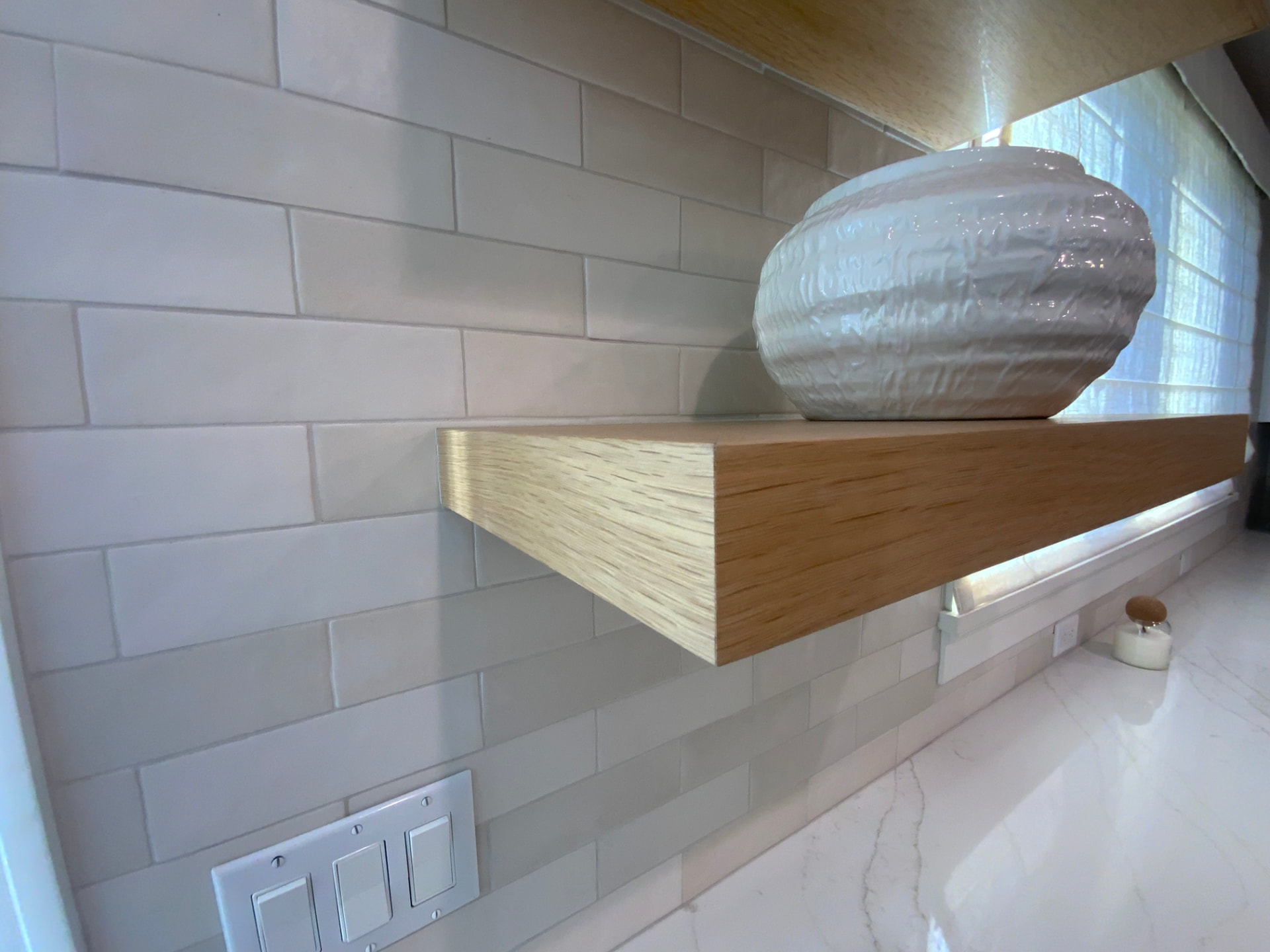
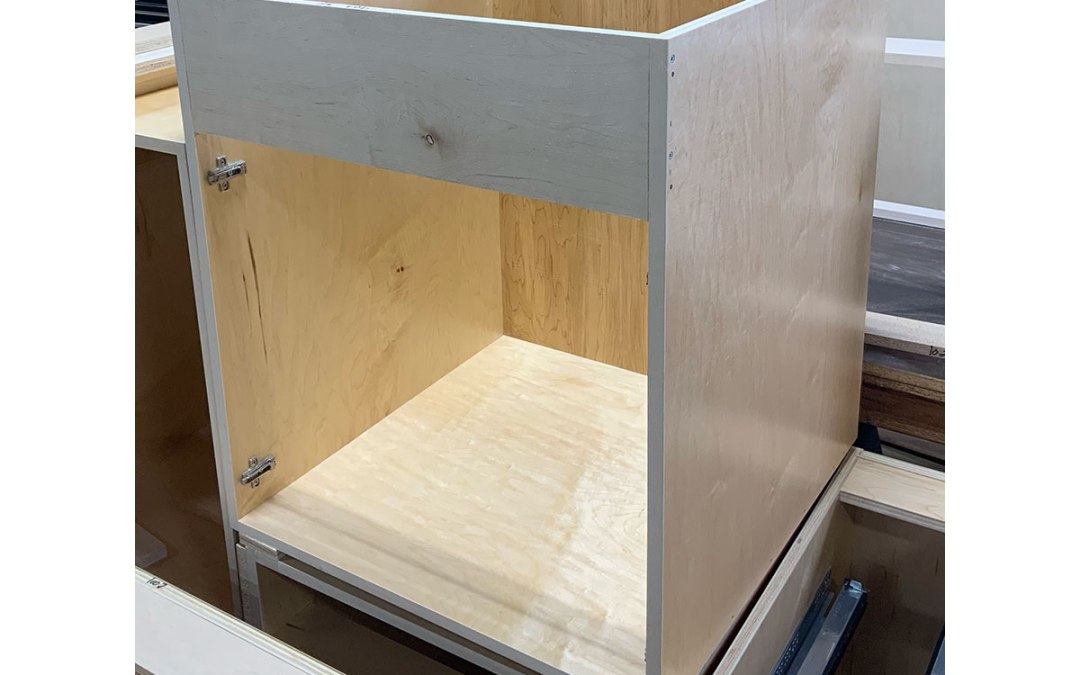
Ask most people to picture a quality shelf and they'll describe a thick slab of solid hardwood. It's an honest instinct — solid wood has romance on its side. But after years of building floating shelves, cabinet boxes, and architectural casework in Orange County, we'll make the case for the material that actually performs better: top-quality domestic plywood with a hardwood face veneer and solid wood edge banding.
This isn't a cost-cutting argument. It's a physics argument.
Wood Moves. Panels Don't (Much).
Solid wood is hygroscopic — it takes on and gives off moisture with the seasons, and it moves across its width as it does. A wide solid shelf will cup, bow, or twist over time, especially one mounted to a wall where one face is exposed to the room and the other isn't. That's not a defect in the lumber; it's just what wood does.
Plywood is built from thin layers with the grain direction alternating at each ply. Those layers cancel each other's movement, so the panel stays flat and dimensionally stable through humidity swings that would have a solid board arguing with its brackets. For a floating shelf — a long, wide, unsupported span — that stability is the whole game.
The Face You See Is Still Real Hardwood
Architectural veneer is not a printed picture of wood. It's a real slice of the same rift white oak, walnut, or maple you'd buy as lumber, laid over a stable core. You get the genuine grain, the genuine color, and the genuine finish behavior — because it is genuine wood, exactly where your eyes and hands meet it.
The edges get solid wood edge banding, so from any angle the shelf reads as solid hardwood. What you don't get is the movement, the checking, and the seasonal gaps that come with the real thing at full thickness.
A Smarter Use of a Finite Resource
Here's the part nobody likes to say out loud: slicing a premium log into veneer yields many times more finished surface than cutting it into thick boards. The same walnut tree that becomes a handful of solid shelves can face dozens of veneered panels — every one of them showing that log's best figure.
Building a shelf from thick solid stock spends a lot of premium hardwood on the middle of the panel, where nobody ever sees it and where it does nothing but move. Veneer construction puts the premium material on the surface and a stable, efficient core underneath. It's how high-end architectural millwork has been built for decades — not as a shortcut, but as the better engineering.
Consistency You Can Specify
For designers and architects, veneer panels solve another problem: repeatability. Order six solid boards and you get six different boards — different color, different figure, different behavior. Architectural veneer can be sequence-matched across a run of shelves or an entire wall of casework, so the elevation you drew is the elevation that gets installed.
Where Solid Wood Still Wins
We'll be honest about the tradeoffs, because there are some. Solid wood can be sanded and refinished more times over its life. Edge profiles and carved details need solid stock. And for certain furniture pieces, the through-and-through nature of solid wood is the point.
That's why we build both. But for flat, wide, wall-mounted work — floating shelves especially — a built-up panel with a hardwood face is the more stable, more consistent, and more responsible way to build. It's the method we recommend, and it's the one we'd put in our own homes.
Questions about which construction is right for your project? Reach out — we're happy to talk materials before you commit to anything.